

Welcome to the website of our project “Archive of Other Memories”, which records queer life stories in video interviews and makes them accessible for research and education. You have come to the right place if you would like to give a life story interview yourself, view and use the interviews we have saved so far, or are interested in possible cooperation projects.
Overview

About the Archive of Other Memories
The “Archive of Other Memories” (Archiv der anderen Erinnerungen – AdaE) is an interview project (oral history) whose aim is to honour the life reality of queer people and render it visible to future generations. Queer life stories in all their diversity are now depicted in 100 biographical video interviews.

Thanks to the support, commitment and expert knowledge of queer groups, various video archives and other experts, it was possible to begin conducting the first interviews in December 2013. Since then, the AdaE has been used every week by interested parties, especially from academia, research and education.
The goals of the AdaE correspond to the foundation purpose of the BMH and are integrated as follows in the foundation Articles of Association: By means of “collection, documentation and academic evaluation of materials and contemporary witness reports”, the lifeworlds and everyday experiences of queer people who live and have lived in Germany are to be researched and made visible.
Preserving these frequently forgotten aspects of the history of West and East Germany is of enormous value to the BMH and the numerous researchers and interested parties who use the AdaE. What is crucial for us is that queer people depict the realities of their lives in their own words.

Unterstützen Sie das Archiv der anderen Erinnerungen!
You would like to tell the story of your life in the “Archive of Other Memories”?
In that case, please feel free to reach out personally and confidentially to Arthur Molt, the project lead within the BMH’s Department of Culture, History, and Remembrance. We welcome any interest and will handle your inquiry with discretion and confidentiality.

You can also contact us by mail:
Anton-Wilhelm-Amo-Str. 34
10117 Berlin
For general questions regarding the archive, you can also reach us at arthur.molt@mh-stiftung.de.
The team
The team for the conduct of the interviews consists of people with different sexual orientations and gender identities and different social, cultural and professional backgrounds. All share an interest and also academic expertise in the past, present and future life situations of LGBTIQ*.
Overview of interviews
Jetzt das “Archiv der anderen Erinnerungen” durchsuchen!
Since December 2013, more than 100 life-history interviews have been conducted. We thank all those interviewed for their trust and their willingness to share their life stories.
Archive use

Sie möchten die lebensgeschichtlichen Interviews für Ihre Arbeit nutzen?
Statistical data (as of end of 2024)
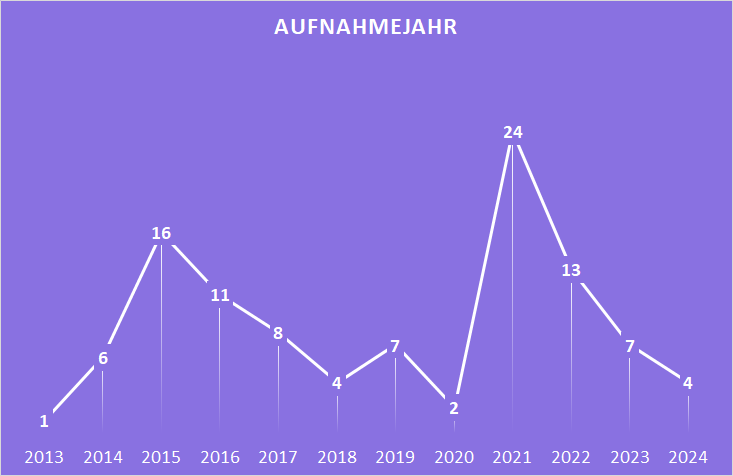
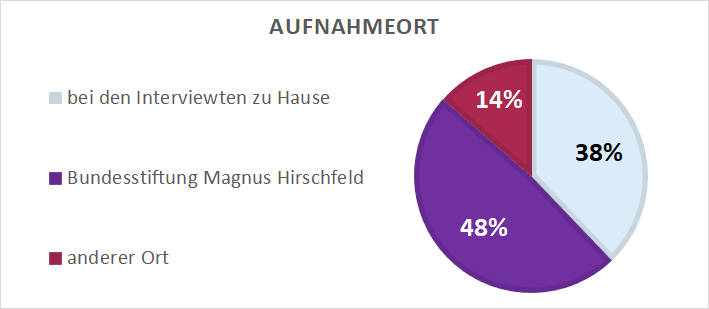
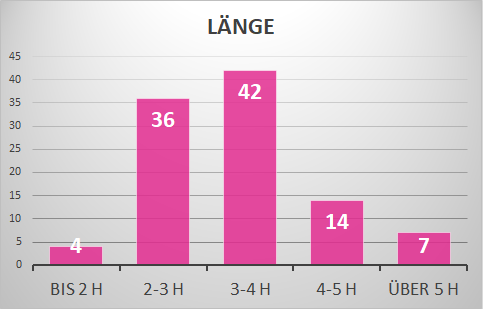
The following statistics provide an overview of the 103 life story video interviews conducted up to the end of 2024 and the interviewees in the “Archive of Other Memories” project.
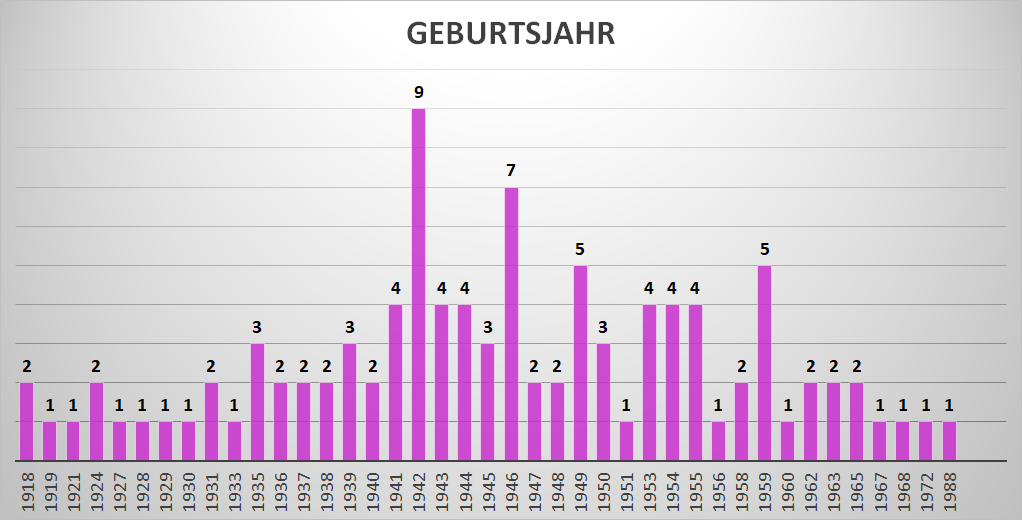
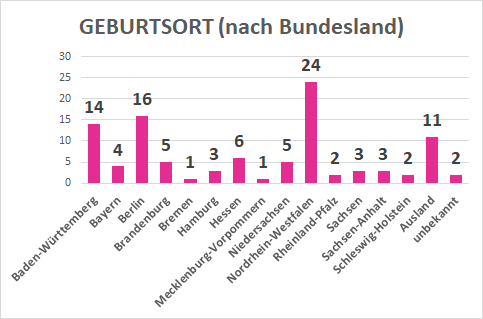
Cooperation projects / films
Note: please take note that the film excerpts accessible here may not be further distributed, copied or saved either.
In various (cooperative-) projects, BMH has produced short versions out of the biographical video interviews lasting several hours. These highlight the main features of individual life stories.
Short film on queer diversity in football
The BMH had a short film made out of the two biographical interviews with Tatjana Eggeling and Burkard Bock for the specialist conference “Queer diversity in football” on 11 October 2023 in the German Football Museum in Dortmund.
Short films for educational modules on queerhistory.de
In 2015, condensed versions of the interviews with Maria Sabine Augstein, Harm-Peter D., Anna Thomann, and Wolfgang Lauinger were created for an educational project in collaboration with the Chair of History Didactics at the Friedrich Meinecke Institute of the Free University of Berlin, the Max Planck Institute for Human Development, the Spinnboden Lesbian Archive and Library, and the Center for Digital Systems at the Free University of Berlin. Educational multipliers and anyone interested can find detailed educational modules on using the films in the classroom at queerhistory.de. For questions about using these life stories, please contact Prof. Dr. Martin Lücke (luecke[at]agentur-bildung.de). The project was made possible with funding from the Federal Ministry for Family Affairs, Senior Citizens, Women, and Youth. Three of the four edited interviews are freely available to the public:
Maria Sabine Augstein (*1949)
Wolfgang Lauinger (1918–2017)
Anna L. Thomann (*1950)
Five short films for the mediation project with www.lsbttiq-bw.de
Since 2016, the BMH has been involved in the joint research project “Lebenswelten, Repression und Verfolgung von LSBTTIQ in Baden und Württemberg im Nationalsozialismus und in der Bundesrepublik Deutschland” together with the Historical Institute of the University of Stuttgart and the Institute for Contemporary History Munich-Berlin. In a mediation project running parallel to the research, the complexity of the topic and initial research results are presented to a broad public via www.lsbttiq-bw.de. In this context, five further short versions of biographical interviews from the “Archive of Other Memories” have been created through a cooperation with the Center for Digital Systems at the Freie Universität Berlin, which you can view with additional information on the life stories at www.lsbttiq-bw.de/zeitzeuginnen-interviews/ and on this page. The mediation project was funded by the Ministry of Social Affairs and Integration of the State of Baden-Württemberg.
Heinz Schmitz (*1943)
Juliane Ernst (*1941)
Richard Moosdorf (*1924)
Herta Leistner (*1942)
Helmut Kress (*1946) (externe Seite, FU Berlin)
“Between happiness and repression – Lesbian, gay, bisexual, trans* in North Rhine-Westphalia, eyewitnesses remember“,
is a collaborative project with the Ministry for Children, Youth, Family, Equality, Flight and Integration of the State of North Rhine-Westphalia and shows a journey through time of six different queer people who take us along on their individual life journey through the past decades.
A piece of contemporary history that brings to life the memory of socio-political developments and the emancipation history of queer people.
Acknowledgements
Numerous institutions, organisations and people contributed to the development of the project and supported the work of the “Archive of Other Memories”. We are grateful to:
Aids Oral History Archiv (AOHA), Berlin
ARCUS-Stiftung, Köln
Bundesministerium der Justiz und für Verbraucherschutz (BMJV)
Bundesministerium für Bildung und Forschung (BMBF)
Bundesministerium für Familie, Senioren, Frauen und Jugend (BMFSFJ)
Federal Association Trans*
Center für Digitale Systeme an der Freien Universität (FU) Berlin (CeDiS)
Deutsche Gesellschaft für Transidentität und Intersexualität (dgti) e. V.
Fachverband Homosexualität und Geschichte e. V. (FHG), Köln
Förderkreis der Bundesstiftung Magnus Hirschfeld (FBMH), Berlin
Forschungsstelle „Kulturgeschichte der Sexualität“ der Humboldt-Universität (HU) Berlin
Forum Homosexualität München e. V.
Friedrich-Meinecke-Institut der Freien Universität (FU) Berlin (FMI)
Historisches Institut der Universität Stuttgart
Institut für Interkulturelle Pädagogik der Technischen Universität Chemnitz
The Berlin State Office for Equal Treatment and Against Discrimination (department LSBTI) at the Senate Department for Labor, Social Affairs, Equality, Integration, Diversity and Anti-Discrimination (LADS)
Lili-Elbe-Archiv, Berlin
Max-Planck-Institut für Bildungsforschung (MPI), Berlin
Netzwerk LSBTTIQ Baden-Württemberg, Freiburg im Breisgau
Queeres Netzwerk Niedersachsen e. V. (QNN), Hannover
QueerNet Rheinland-Pfalz e. V., Mainz
Rad und Tat – Offene Initiative lesbischer Frauen (RuT), Berlin
Spinnboden Lesbenarchiv und Bibliothek e. V., Berlin
Stiftung Akademie Waldschlösschen, Göttingen
Stiftung Denkmal für die ermordeten Juden Europas, Berlin